The board on a phone
The phone layout switches on a screen narrower than 768 pixels, at the same address as the desktop, and each card and each stopped item offers its own buttons. To reach the board from a phone, see Reach the board from your phone.
The layout
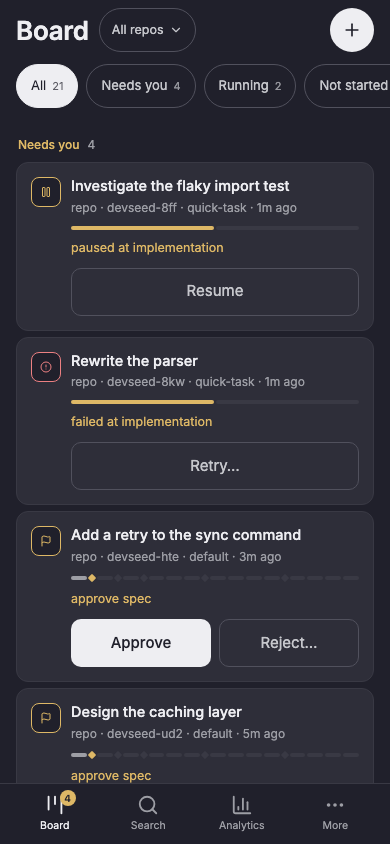
The layout switches on its own when the window is narrower than 768 pixels, with no setting to turn on. It is the same app at the same address, so a link copied on one opens on the other. Widening the window brings the desktop layout back on the same page.
- A bar at the bottom holds Board, Search, Analytics and More.
- More lists everything else: Chains, Library, Repos, Forge accounts and Harnesses, then Policy, Auto-intake, Notifications, Access, Appearance, Board & code and About, then Analytics and Archived. An archived item opens from there, and Restore on the item puts it back on the board.
- The phone has no first-run wizard. With no repo connected, the board says
"No repository is connected": connect one from a computer, or run
kraft repo connectin the repo on the machine Kraft runs on.
A phone screen the desktop has no page for lands on the nearest desktop page, when the window widens or a link sent from a phone opens on a laptop. More lands on the board. One harness, agent profile, schedule or notification channel lands on its list, with the harness or agent profile selected.
The board on a phone
The board filters by All, Needs you, Running, Not started and Done, the desktop board's groups. The + button files a new work item (New work item), as File a work item describes.
A card that needs you carries its own buttons:
- Approve and Request changes… for a gate;
- Answer… for a question;
- Retry… for a failed item;
- Raise cap for a cap and Raise budget for a dollar cap. Those two open the item with its raise sheet over it, or on its card, which says why, when the item can't raise it.
Tap the card for the item. Approve asks first, naming the node the item moves on to, since a passed gate isn't taken back. Open the review there reads the gate's document instead.
After kraft admin update installs a release under a running server, the board
says so in a line under its filters, as the desktop's sidebar does. Restart to
finish the update. For an older release installed over a newer one, read About
first.
An item on a phone
An item opens as its chain, node by node. Tap a node for its tasks, a task for its log.
- A node whose fix loop has gone past its first round shows a chip for each round. Tap one to see that round's tasks, and the loop's repair and judge for it. Each opens like any other task.
- A node the chain ran again, after a gate rejection, a retry or a base change, shows a chip for each pass above the rounds. Tap one for that pass's rounds, tasks and logs. A task or scope opened from it says which pass it is.
- A gate asked more than once shows a chip for each round, such as round 1 · changes requested, wrapped onto as many lines as it needs. Tap one for that round's decision, who made it and where it sent the work, with the first paragraph of its note, rendered and clipped at three lines. When the note has more, Read the note opens the whole note in a sheet. A gate asked once has no chips.
- A review round, one with a review or review threads, also shows the review's summary, the thread count line and its first three threads. The review's outcome shows only when it differs from how the round ended. The note stays beside the review, unless it was the review-thread bounce's. Open in review goes to that round, read-only, where each thread names its file and lines.
- A task that ran more than once in a round offers its attempts. A test task that picks scopes lists them instead, each with its command. When the item spans several repositories, each scope is under its repository's name.
- Tap a scope for its command, the paths that select it, how the other rounds treated it and, once it has run, its log.
- A test task reads failed when one of its scopes failed, even if a later one passed.
- A sliced item's slices node lists its shared groundwork, each slice (tap one to open its own item) and the join. Its row on the chain says how far the slices are, and turns amber when one needs you.
- A slice's header names its parent first; tap it to go to the parent.
- Review opens the gate's document and diff.
- Comments you added there and haven't sent are counted as pending, beside the document's name too, and each is marked pending.
- A thread names its lines as the desktop does (
lines −2 to +6) and quotes them. A thread on the whole change is listed above the files. - Approve asks first, since an approval can't be taken back; with pending comments it asks before it sends them with the approval.
- An item that hasn't started offers Start. When its draft holds changes Start wouldn't apply, Start lists them and asks first: Apply and start, or Start without them. A spec or plan attached when it was filed is listed under its title; tap one to read it.
A node's bar offers Retry node only once the item has stopped. On a paused item it offers Skip node and Resume. A node waiting on CI offers Pause and Skip node. A rate-limited node offers only Pause, so pause it first to skip it.
Sub-agents
Added in 2.6
When Claude Code ran sub-agents in a task, their log lines start with ↳ and the
sub-agent's description. A chip on its own row above the log, agent: All,
opens a sheet to show one sub-agent's lines, or only the main agent's.
While sub-agents run, the item's Log block says so, for example
2 sub-agents running: Explore codebase, Review diff; tap it to open that task's
Overview. There, a Sub-agents list groups them as Running, Didn't
finish and Finished. Finished stays folded until you tap it, unless it is
the only group. Each row shows tokens, tool uses and time, with its last tool
while it runs or the start of its answer when it is done.
Tap a row to open the log filtered to it, or Prompt to read what it was asked. A sub-agent still running when its session ended reads cut off.
The bar on a stopped item
A stopped item has an action bar at the bottom with one or two buttons, chosen by why it stopped:
| Why it stopped | The bar offers |
|---|---|
| At a gate | Request changes… and Review |
| A failure, or most other stops | Escalate and Retry |
| A question | Escalate and Answer |
| A merge conflict | Cancel… and Review the conflicts |
| A closed merge request | Cancel… and Reopen MR |
| A cap that names its limit | Steer and Raise cap |
| A cap that names no limit | Steer and Retry |
A dollar cap the item can raise (its own cap, or the item-wide budget_usd) | Raise budget alone, with no Steer |
| A daily, token or node-level cap | Retry alone |
| An escalation running | Retry, which stops the escalation and retries the node |
| Waiting on a rate limit or on CI | Pause alone |
| Blocked behind an unfinished item, which its card lists | Unblock and Pause |
- Steer retries the node with your note. Raise cap opens a one-number sheet titled for that limit, such as Raise the running time cap.
- For a daily, token or node-level cap, the card says the item can't raise that cap, so raise it in the policy or the chain first.
- While an escalation runs, its node bar offers Retry node. Pause, Steer and Skip wait until the escalation answers.
- An item waiting on a rate limit or on CI is retried by Kraft itself. Its node reads waiting on CI or waiting · rate limit, not running.
Approve a one-off chain
Added in 2.5
Start on an item whose one-off chain
holds custom content nobody approved opens a sheet, Approve this chain, then
start?. It lists what the chain adds, overrides and removes, then each custom
part in full. Approve and start approves what the sheet showed and starts the
item. Kraft records phone as the door.
A sheet that opened without a tap, on a reload or Forward, with nothing left to approve, asks Start this item? and starts nothing until you tap Start.
The item screen's meta line says where the chain stands: one-off chain · approved by you on a phone · 5m ago once it is approved (in the web UI for an
approval on a computer), or one-off chain · custom content, not approved yet.
A one-off chain with no custom content shows only one-off chain.
Forge accounts
Added in 2.5
More > Forge accounts lists each account with its token source and the
state of its last check. Tap one to Test it, Paste a new token (an API
account that isn't set by a command), or Remove it. A token you paste is
sent once and never shown again. Add an account or change its addresses on a
wider screen, or with kraft admin forge in a terminal.
Related
- Reach the board from your phone: make the server reachable and sign in.
- The board: the desktop board's groups and rows, which the phone's filters mirror.
- Raise a cap on a stopped item: what Raise cap and Raise budget open.
- Analytics: the Analytics tab on a phone.