PRODUCT · HOW IT WORKS
How Kraft runs a work item.
01 · CHAINS
A process the agent can't skip.
Each work item follows a chain, a YAML file you can read and diff.
Its nodes are steps such as write the spec, implement, verify and open the merge request. Some run your agent, some run a command and some stop for you.
Docs: The real chain- 01spec
- 02spec_approvalYOU
- 03plan
- 04plan_approvalYOU
- 05chain_revision
- 06chain_revision_approval
- 07implementation
- 08verification
- 09work_brief
- 10local_reviewYOU
- 11describe_merge_request
- 12draft_merge_request
- 13merge_request_feedback
- 14work_item_summary
- 15final_reviewYOU
- 16mark_ready
- 17external_approval
- 18merge
- 19post_merge_ci
02 · GATES
A person at the decisions.
A gate is a node where the chain stops for you. Read what the agent wrote, then approve it, or request changes with a note that re-runs the node that wrote it.
The default chain waits for you at the spec, at the plan, before it opens a draft merge request, and before it marks it ready.
Docs: Reviewing a change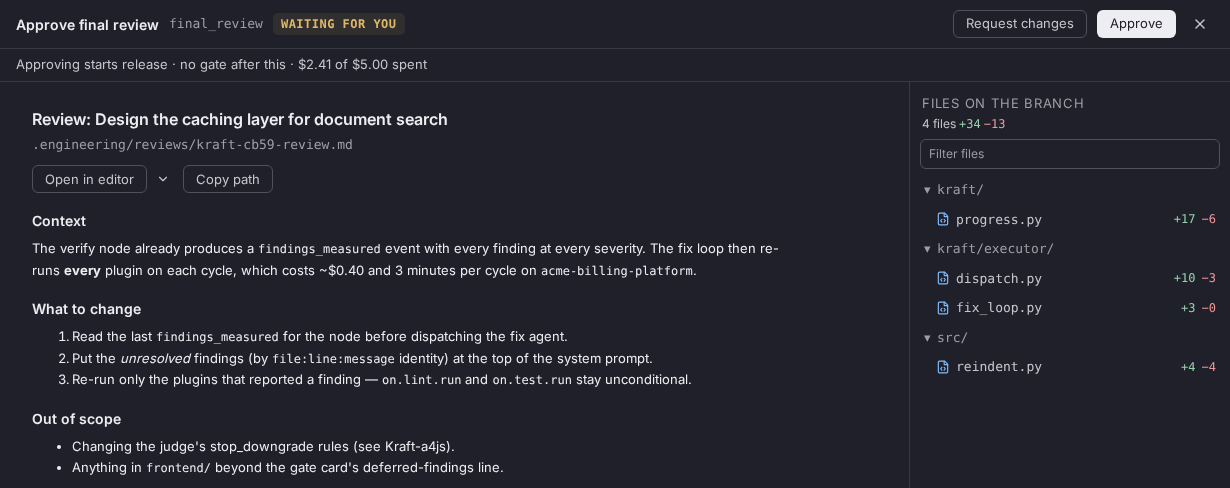
03 · INDEPENDENT CHECKS
Checks it doesn't grade itself on.
Kraft runs your tests in a node of its own, waits for your CI and has a separate reviewer decide whether a fix is done.
When verification fails, an agent repairs the change and Kraft measures the whole node again. After the first repair, a judge rules whether another attempt is worth it.
Docs: Fix loop and judge04 · CAPS AND BUDGETS
Capped retries and spend.
Loops limit how often a node repeats. Caps limit the time, tokens and dollars a scope may use.
Whichever runs out first stops the item and hands it to you, with the full trace, instead of failing it.
Docs: Caps and budgets- A DAYdollars · $50 as shipped
- A WORK ITEMtime, tokens, dollars · $10 as shipped
- A NODEtime, tokens, dollars
- ITS FIX LOOPverification: 2 attempts, 1 hour
- A STEPtime, tokens, dollars
- A TASKtime, tokens, dollars
- A NODEtime, tokens, dollars
- A WORK ITEMtime, tokens, dollars · $10 as shipped
05 · WORKTREE ISOLATION
Your checkout stays as you left it.
Each item runs on its own branch in its own git worktree, so items run in parallel.
Archiving an item removes its worktree, and its branch once its commits exist somewhere else.
Docs: How a work item runs06 · WAYS IN
File work from wherever you are.
You file a work item, and it waits paused until you start it.
Gates clear from the same places: the board, a phone, VS Code or the command line.
Docs: File a work item- Web UI
- File, start and review on the board.
- Phone
- The same UI, reached over a tunnel.
- Command line
kraft item create- Agent session
- Slash commands and MCP tools, from the Kraft plugin.
- VS Code
- Clear gates beside your code.
- Trigger
- A schedule or an API call files the item, paused.
07 · SANDBOX
A container for the agent, when you want one.
Without a sandbox, workers run directly on your machine, as your user. None is set by default.
A sandbox runs a repository's workers in a container, with resource limits and a list of hosts they may reach. Only a sandbox with a network policy keeps an agent from deciding its own gates.
Docs: Sandboxed workersrepos: - path: /home/you/code/my-service sandbox: kind: docker image: ghcr.io/acme/agent@sha256:... resources: {cpu: 2, memory: 4g, pids: 512} network: install: {allow: [registry.npmjs.org]} runtime: {allow: [api.github.com]}